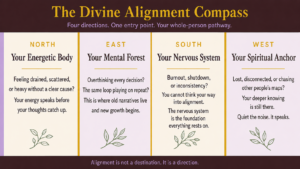
Your body kept score before your brain had words for it.
Grief does not disappear. It reorganizes. It migrates from your chest to your shoulders, from your throat to your jaw, and if you give it enough time and enough unprocessed moments, it will settle somewhere deep and quiet in your hips and pelvis. And it will wait.
You have probably journaled. You have talked to someone. You have cried, prayed, processed, maybe even convinced yourself you were “through it.” Yet something still pulls when you sit too long, tightens when you reach for a low shelf, or aches dull in your lower back when the world gets too loud.
That is not a failure of your inner work. That is your nervous system, still holding what your mind could not fully integrate.
This is where somatic release and vagus nerve regulation come in. In this post, you will understand how the nervous system stores emotional experience, why the hips are such a common site of that storage, and what practical somatic practices can support your body in moving grief through, at your own pace, on your own terms.
Somatic release refers to body-based practices that support nervous system regulation by allowing stored emotional tension to move through physical sensation rather than mental processing alone. The vagus nerve is one of the body’s key regulation pathways; when vagal tone is supported through extended exhale breathing, gentle humming, and grounded hip-opening postures, the nervous system may begin to register enough safety to release what it has been holding. The hips are a common site of stored emotional tension because the psoas muscle, located deep in the hip flexor, is one of the first muscles to contract under stress and may remain chronically braced through prolonged grief or loss.
Key Takeaway:
- Somatic release focuses on the body’s role in processing stress and grief through gentle movement, breathwork, mindfulness, and body awareness. While emotional experiences can be accompanied by physical tension, evidence does not support the idea that emotions are literally stored in specific body parts such as the hips. [1]
- Practices that encourage slow breathing, mindful movement, and relaxation may help regulate the nervous system and support a greater sense of calm. These approaches can complement emotional healing by increasing awareness of bodily sensations and reducing chronic stress responses. [1]
- Healing from grief is a gradual process. Combining somatic practices with reflective journaling, supportive relationships, coaching, or therapy can help individuals process difficult emotions while building resilience and emotional flexibility over time. [2]
- Somatic exercises are intended to support well-being rather than replace professional care. If grief feels overwhelming, persists for an extended period, or significantly affects daily life, seeking guidance from a qualified mental health professional is recommended. [2]
Bottom Line: Gentle somatic practices can support nervous system regulation and provide a compassionate way to navigate grief. When combined with self-awareness and appropriate professional support, they may help foster emotional resilience, greater body awareness, and a deeper sense of balance.
- Source: Divine Empowerment Coaching – Somatic Release: Regulating the Vagus Nerve and Moving Grief Through the Hips
- Source: FAQs Section
What Is Somatic Release and Why Does It Matter?
Somatic release refers to body-based practices that support nervous system regulation and allow stored emotional tension to move through physical sensation rather than mental processing alone. The word somatic comes from the Greek soma, meaning body. It is not a form of advanced yoga or a stretching routine. It is a deliberate shift in attention, from analyzing your experience to feeling it in real time.
What “Somatic” Actually Means
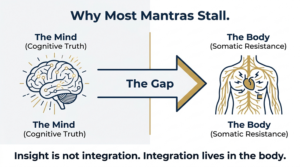
Most people who have processed grief through talk therapy or journaling have done powerful cognitive work. But cognition is only one lane on a two-lane road. The body runs parallel to the mind, and it speaks a different language, one made of sensation, tension, breath, and involuntary response.
Somatic practice asks you to drop into that second lane. You are not trying to think your way through grief. You are giving your body permission to complete a process it may have started months or years ago.
Why the Body Stores What the Mind Tries to Move Past
The nervous system is wired to prioritize survival above everything else. When an emotional experience arrives faster than your system can integrate it- loss, shock, prolonged stress, relational rupture – the body does what any smart system does. It holds it. It braces. It keeps the unresolved material tucked away where it will not interfere with your ability to function.
That is a feature, not a flaw. But if the holding never gets released, those patterns of tension become the body’s resting state. You stop noticing them. They become background noise. And then one day a therapist or a yoga teacher presses on something in your hip and you cry without knowing why.
That is the body doing exactly what it was always trying to do. It was waiting for a safe enough moment to let go.
According to research on somatic practices for emotional processing, body-based interventions can support nervous system regulation in ways that verbal approaches alone sometimes cannot reach.
The Vagus Nerve: Your Nervous System’s Regulation Pathway
What Is the Vagus Nerve?
The vagus nerve is commonly described as the longest cranial nerve in the body. It originates in the brainstem and branches through the neck, chest, and abdomen, influencing the heart, lungs, and digestive organs. It is one of the body’s major communication pathways between the brain and internal organs, and that communication runs in both directions. In fact, much of the information carried by the vagus nerve travels from the body back to the brain.
When researchers talk about the mind-body connection, the vagus nerve is much of what they mean. Vagal tone refers to how effectively this system helps the body respond, recover, and return toward balance. Healthy vagal regulation may support steadier breathing, heart-rate recovery after stress, digestion, and the capacity to feel grounded enough to process emotional experiences rather than simply brace against them.
The work of psychiatrist and researcher Stephen Porges, founder of polyvagal theory and safety signals, offers us a framework for understanding how the nervous system may move through states of connection, mobilization, and shutdown in response to cues of safety or threat.
Through this lens, grief can sometimes pull the body toward a protective shutdown response, often associated with the dorsal vagal pathway. This may feel like numbness, flatness, heaviness, exhaustion, or a vague sense of disconnection from yourself, others, or the world around you.
This does not mean something is “wrong” with you. It may be your nervous system’s way of conserving energy when an experience feels too overwhelming to fully process all at once.
How Dysregulation Keeps Emotional States Stuck
When your nervous system feels regulated, emotions tend to have more room to move. Your breath may slow. Your chest and belly may soften. You may still feel sadness, anger, grief, or fear, but those feelings are more likely to rise, be felt, and eventually shift.
When your nervous system is dysregulated, emotions can feel trapped in a loop. Breath gets shallow. The body tightens. Thoughts repeat without resolution. Feelings hover just beneath the surface, but never fully move through.
The body is not being dramatic. It is communicating with us.
Research on vagal tone and emotional regulation suggests that lower vagally mediated regulation is often associated with reduced emotional flexibility and more difficulty recovering after distress. In simple terms, when the body has a harder time returning to baseline, emotional states can feel more sticky, repetitive, or unresolved.
Supporting vagal tone does not have to be complicated. It begins with small, repeated cues of safety: a longer exhale, a low hum, supported rest, gentle movement, grounding, and connection.
Over time, these practices can help the body remember that it does not have to stay braced forever.
Safety Signals and the Body
This is the part most people skip, and it is the part that determines whether somatic work actually lands.
Your body is less likely to release what it is holding until it registers that it is safe to do so. Not intellectually safe. Physiologically safe. There is a difference. You can tell yourself you are safe while your breath is shallow, your jaw is clenched, and your shoulders are at your ears. Your thinking mind may understand the message, while your body is still responding to threat cues.
Somatic practice works by helping create the conditions for physiological safety: through breath, posture, sound, grounding, slowness, and supportive presence. When the body begins to register safety, the nervous system can soften. And when the nervous system softens, what has been held may finally begin to move.
The body does not open by force. It opens through safety, repetition, and trust.
Why Grief Can Show up in the Hips
The Psoas Muscle and Emotional Memory
Deep in your core, connecting the lumbar spine to the femur, sits the psoas major. Many people do not know they have one until it announces itself through a tight low back, difficulty straightening after sitting, hip tension, or an ache that stretches alone and no amount of foam rolling seems to resolve.
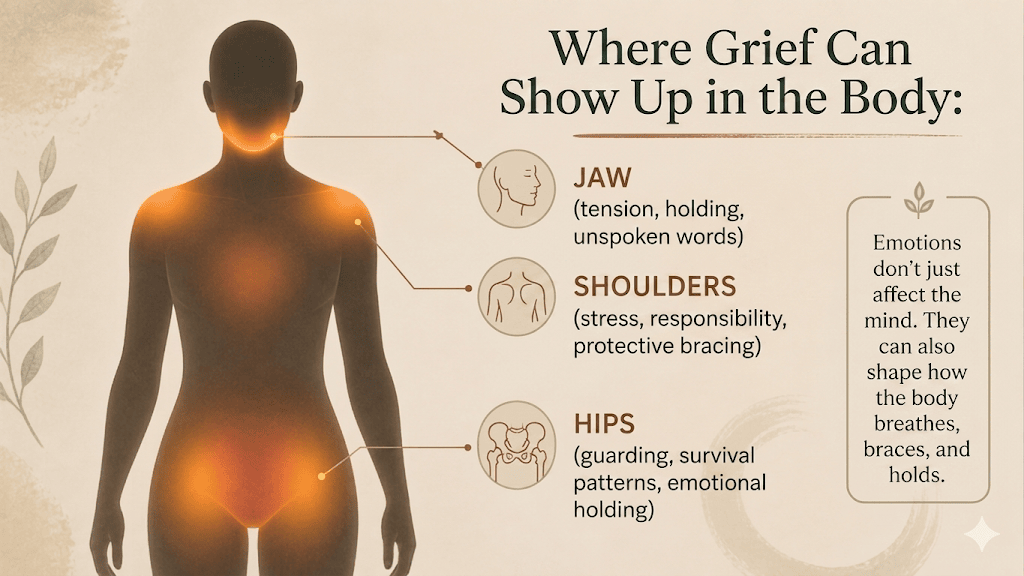
The psoas is one of the body’s primary hip flexors. It helps lift the thigh, stabilize the pelvis, and support posture and movement. Because of its location and relationship to the spine, pelvis, diaphragm, and breath, it can also be affected by stress, bracing, and protective body patterns.
It is also one of the first muscles to contract under perceived threat. When your nervous system registers danger, whether that danger is a predator, a car accident, or the kind of prolonged emotional stress that comes with grief, the psoas braces. It pulls you forward and inward. It protects. For some people, this can include tension through the hips, pelvis, low back, and deep core.
When that contraction becomes chronic, the psoas begins to shape how you hold yourself, how you breathe, and how comfortable you feel in your own body, including how freely emotion can move through your pelvis. This does not mean the psoas “stores grief” in a literal way, but it does mean grief and stress can influence muscle tone, posture, breath, and the body’s sense of safety. Research on the psoas muscle and the stress response points to its role not just in physical function but in the body’s overall relationship to safety and activation.
Recognizing Stored Tension in the Body
You do not need a bodyworker to tell you your hips may be holding something. The body has its own vocabulary.
Notice: Is there tightness when you stand after sitting for an hour? Resistance, emotional as much as physical, when you try a hip opener? A dull, low-grade ache in your pelvis or sacrum that seems to come and go with your stress levels? A subtle bracing in your lower belly, as though you are always preparing for something?
These are not problems to diagnose. They are signals to become curious about.
The invitation is not to force the body open. It is to listen for what the body has been trying to say.
Sacral Chakra Connection
In energy-based frameworks, the hips sit within the territory of Swadhisthana, or the sacral chakra. This energy center is traditionally associated with emotional flow, creativity, relational connection, sensuality, and the capacity to experience pleasure and grief in equal measure.
When this center feels restricted through prolonged stress, unprocessed loss, or patterns of emotional suppression, you may experience both numbness and overwhelm, sometimes in the same afternoon. The body is not confused. It may be cycling through what it has not yet had enough safety, space, or support to fully integrate.
Supporting the sacral energy center through movement, ritual, and intentional nourishment can be part of a whole-body approach. LMH Tea’s Swadhisthana Sacral Chakra Flow was formulated specifically to support the energetic and sensory qualities traditionally associated with the sacral center: earthy, grounding, fluid, and designed for moments when you need to come back to your body. This tea is not meant to “fix” grief or force emotional release. It is a ritual support, a warm, sensory anchor for returning to the body with more presence and compassion.
Body Awareness Pause. Before you read the next section, take a breath. Just one. Let your exhale be longer than your inhale. Now notice, without judgment and without trying to change anything, what is happening in your body. How do your hips feel right now? Tightness? Ease? Numbness? Neutrality? Whatever is there, it belongs. You do not have to move it. We must first begin by learning to notice.
How to Regulate the Vagus Nerve Through Somatic Practice
Breathwork That Helps Engage the Vagal Brake
The exhale is one of the places where regulation begins.
Physiologically, a slow, extended exhale can help engage the parasympathetic nervous system, the branch associated with rest, digestion, recovery, and emotional processing. A longer exhale than inhale is one of the most accessible self-regulation tools we have. It requires no equipment, no app, and no prior experience.
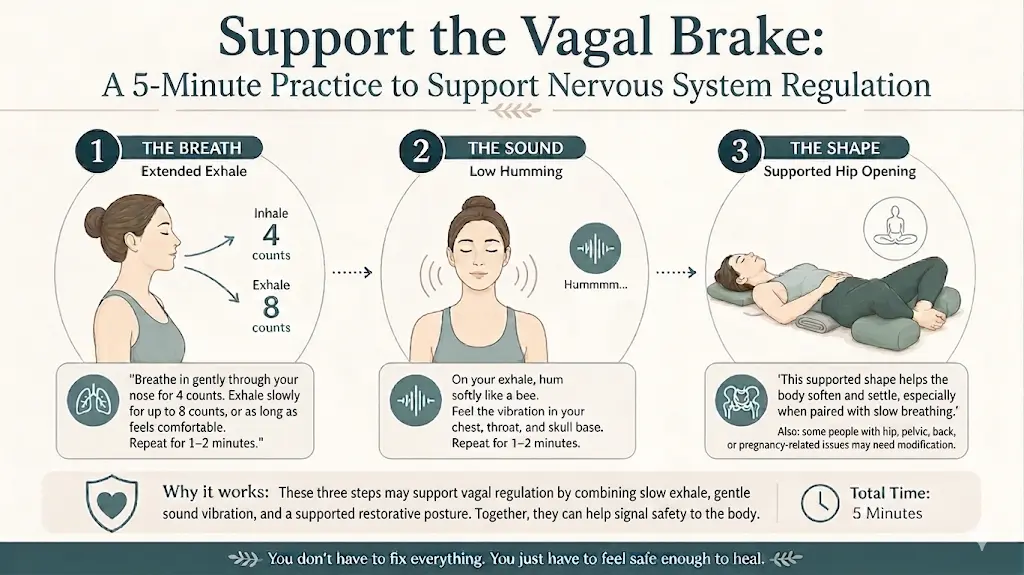
Try this as a gentle starting point: Inhale through your nose for around four counts, whatever feels comfortable for your body. Exhale slowly through your mouth for around six to eight counts. Repeat for two to three minutes, or as long as feels supportive. If you feel lightheaded, dizzy, or uncomfortable at any point, return to your natural breath.
Do not force it. Do not force it. Just let the exhale be a little longer than the inhale and notice what shifts.
This is not breathing for relaxation. It is breathing to support the vagal brake, a neurological term often used to describe the nervous system’s ability to slow activation and help the body return toward regulation.
According to resources from the Polyvagal Institute, extended exhale breathing is commonly used as an accessible tool for supporting vagal regulation and helping the body move toward a greater sense of safety.
Sound and Humming
This one may surprise some people. Humming, low, slow, felt in the chest and throat, may help support vagal engagement through the laryngeal branch that is involved with the breath, voice, throat, and vocal cords.
You do not need to be musical. You do not need to hum a song. You need only to close your lips, drop your jaw slightly inside your mouth, and let a low sound vibrate from your chest. Feel it in your sternum. Feel it in your collarbone. Let it be whatever it wants to be.
This is not meditation theater. This is physiology. The vibration of your own voice, directed inward, paired with a slow exhale, can become a powerful signal of safety to your nervous system.
Grounding Postures That Open the Hips
The goal here is not a deep hip stretch. The goal is duration and attention.
Choose a shape that creates mild sensation in the hips without demanding a performance of flexibility. A reclined butterfly (soles of feet together, knees dropped open, supported with folded blankets under each thigh), a slow low lunge held with support if needed for several minutes, or simply lying on your back with your knees wide apart and feet flat on the floor. If you feel sharp pain, numbness, tingling, dizziness, or emotional overwhelm, come out of the posture and choose a more supported shape.
Get into the shape. Breathe. Stay.
In somatic and restorative practices, stillness often matters more than intensity. The nervous system needs time, not force, to register that a posture is safe. When the body feels supported enough to stop bracing, it may begin to soften and unwind. In somatic and restorative traditions, stillness often matters more than intensity. The nervous system may need time, not force, to register that a posture is safe.
A Simple 5-Minute Somatic Reset Flow
This is for the days when you have five minutes and a floor.
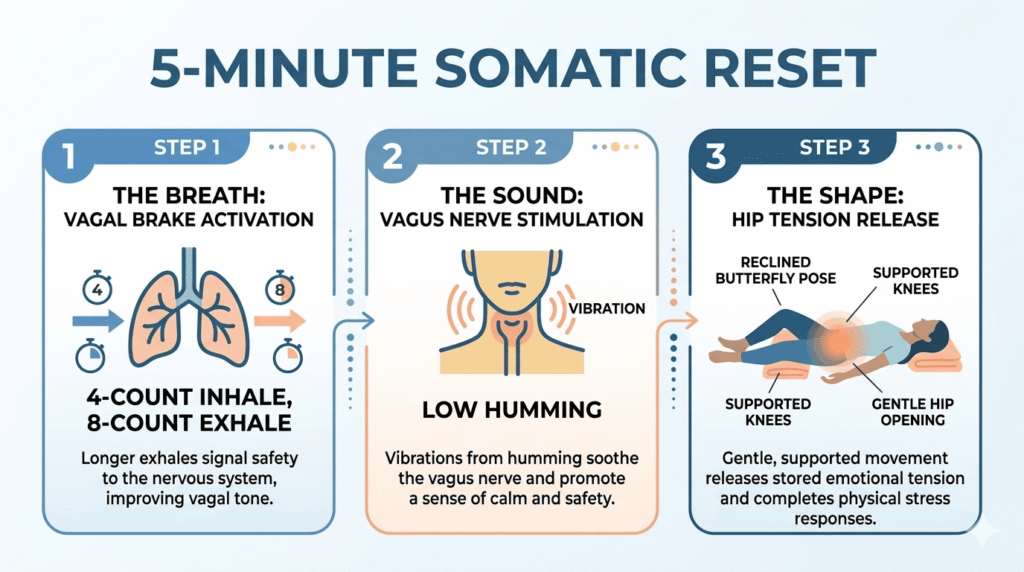
Sit or lie down. Place one hand on your lower belly, just below your navel. Begin the extended exhale breathing from above. After two to three minutes, allow your knees to fall gently apart, supported with pillows if needed. Add a slow, low hum on your exhale if it feels natural. Stay for the remaining time. Do nothing else.
This is not performance. This is support. You are not trying to force anything up or out. You are creating the conditions in which your nervous system can begin to recognize that it does not have to hold quite so tightly.
What Does Somatic Release Actually Feel Like?
Unexpected Emotional Responses Are Normal
You may cry without knowing why. You may feel a wave of sadness that has no narrative attached, no memory, no image, no story. Just sensation. This is not necessarily a breakdown. This may be the body completing a process that the mind never had to narrate.
Grief moves through the body before it moves through language. If you have ever wept at a piece of music that had nothing to do with your loss, you already know this. The body does not always wait for context. It may begin releasing when it registers safety.
Physical Sensations You Might Notice
Tingling in the legs or feet. Warmth spreading through the pelvis. A heaviness that shifts to lightness partway through a practice. A breath that arrives deeper than you expected, without effort. A subtle shaking, not distress-but possible discharge- that passes in a few seconds.
All of this is observable information. None of it needs to be forced, fixed, or over-managed. Your role is to stay present, breathe, and respond gently to what your body is showing you.
How Long Does It Take to Notice a Shift?
This depends entirely on your nervous system and its current relationship to safety. Some people notice a subtle shift in their first session. Others build slowly over weeks before something tangible moves.
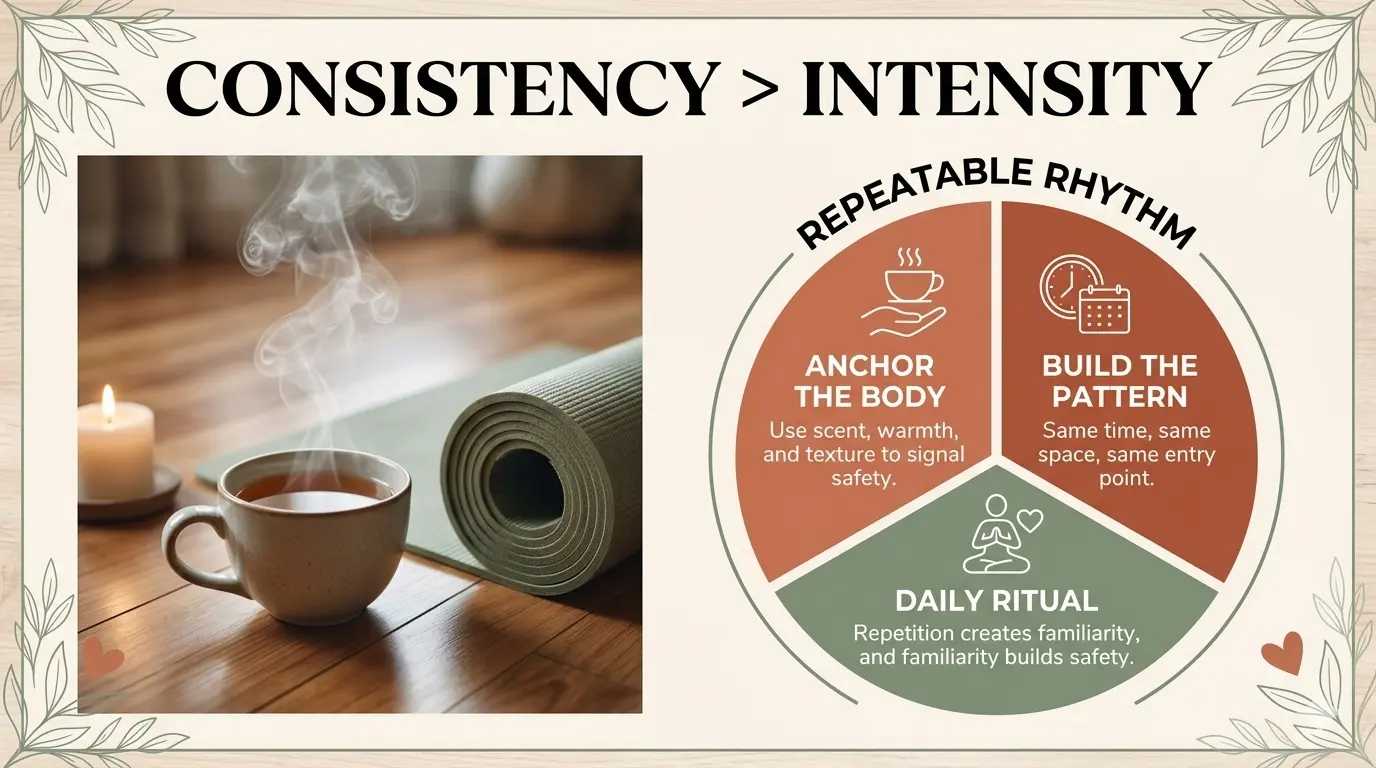
What somatic research continues to affirm: consistency often outperforms intensity. One five-minute practice done daily can do more for nervous system regulation than a single two-hour session done once a month. Small exposures, repeated often, help build new patterns. That is how the nervous system learns safety.
How to Build a Somatic Practice That Actually Sticks
Pair It With a Sensory Ritual
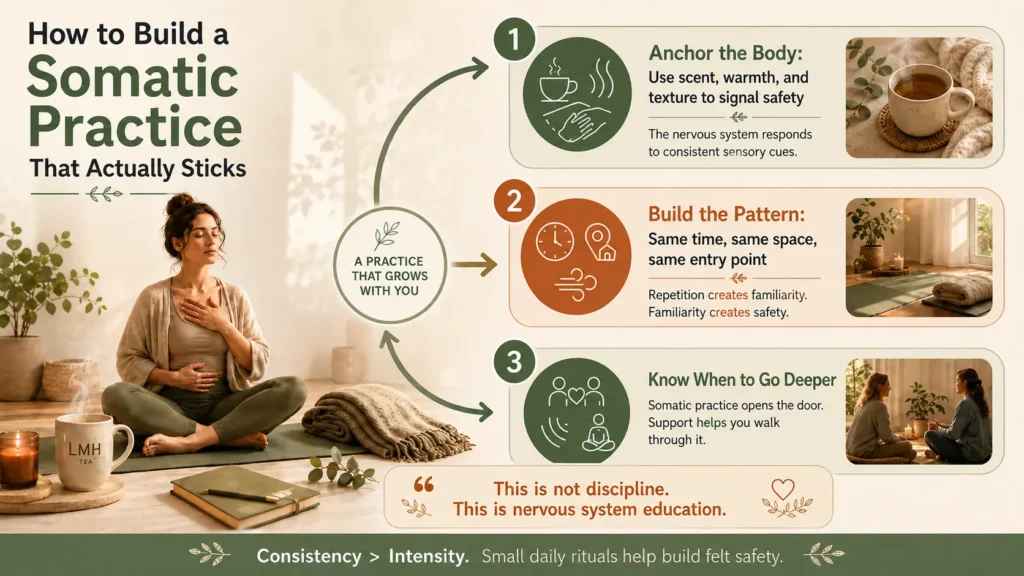
The nervous system responds well to anchors, sensory signals that tell the body a particular state is coming. A specific scent. A particular texture. The warmth of a ceramic mug.
Before or after your somatic practice, build in a sensory grounding ritual. Brew something warm and intentional. Sit with it before you begin. Let the smell, warmth, heat, and texture register in your body before you move into the practice itself.
LMH Tea’s Swadhisthana Sacral Chakra Flow works beautifully here. Formulated to support the energetic qualities of the sacral center, it brings grounded, earthy sensory input to the body before you ask it to open. That kind of intentional pairing is how rituals become meaningful. Supportive, complementary, and deeply personal, this is not a prescription. It is a practice.
“I show myself grace in all things.” That includes being in a body that is still working through something. You are not behind. You are in process.
Create a Repeatable Rhythm
Same time of day. Same entry point, whether that is breath, posture, or a cup of tea. Same physical space if possible.
The nervous system is a pattern recognition machine. Repetition builds familiarity, and familiarity helps build felt safety. Over time, your body will begin to soften before you even start the formal practice, because it recognizes the cues that the ritual is beginning.
This is also where the R.O.O.T. Method finds its entry point: Root, Orient, Open, Transform. A somatic practice that begins to regulate can become the foundation from which identity-level work becomes possible.
When to Seek Deeper Support
Somatic practice is powerful. It is also, by design, a solo tool, and some of what grief holds requires more than a solo tool.
If you feel like you are close to something but cannot quite access it, if you cycle through opening and shutting down without resolution, or if you are ready for guided support that goes beyond what a practice you do alone can offer, that is not a sign of failure.
That is discernment.
Energy-based work can support what somatic practice opens. Reiki-informed energy sessions may be used as a complementary practice to support relaxation, energetic clearing, emotional grounding and nervous system awareness. For deeper, identity-level work, the kind that explores what patterns underneath the grief were already asking for attention, a Divine Empowerment trauma-informed coaching session may be where you are ready to go next.
FAQs
What is a somatic release?
Somatic release refers to body-based practices that support nervous system regulation and allows emotional tension to move through physical sensation rather than mental processing alone. It does not require specific flexibility or prior experience, only willingness to notice what the body may be holding and respond with curiosity instead of force.
Why do the hips hold emotional tension?
The hips house the psoas muscle, one of the body’s primary hip flexors and a muscle often involved in protective bracing and stress-response patterns.
The hips also correspond, in energy-based frameworks, to the sacral chakra, the center traditionally associated with emotional flow, creativity, sensuality, and relational experience.
Grief and prolonged stress frequently produce chronic contraction in this area.
How does the vagus nerve affect emotional processing?
The vagus nerve is one of the body’s major communication pathways between the brain and internal organs. It plays an important role in parasympathetic regulation, which influences how the body shifts between stress, recovery, rest, digestion, and connection
When the nervous system feels safer and more regulated, emotional experiences may become easier to process instead of staying stuck in a protective holding pattern. Supporting vagal tone through breathwork, sound, gentle movement, and grounding practices may help the body move toward greater emotional fluidity over time.
Conclusion
Grief does not only live in the mind. It is felt through the body, breath, posture, muscle tension, fatigue, numbness, bracing and the nervous system’s relationship to safety.
The vagus nerve is one regulatory pathway. The hips can be an access point. And somatic practice is not about forcing anything out. It is about creating the conditions where your nervous system feels safe enough to stop holding so tightly.
You do not have to rush this. You do not have to perform this. You only have to show up, breathe a little longer on the exhale, and let the body do what it has always known how to do when it feels safe enough.
If you are ready to go deeper than what a solo practice can offer, start with a conversation. Book your free 15-30 minute consultation and let’s look together at what your body and your nervous system are actually asking for.
You are whole as you are. And there is more available to you than you are currently accessing.
Disclaimer: I am a Certified Coach and Reiki Master; I am not a certified herbalist, licensed medical doctor, or pharmacist. The botanical suggestions, tea profiles, and lifestyle rituals offered on this website and during coaching sessions are for educational and informational purposes only. They have not been evaluated by the FDA and are not intended to diagnose, treat, cure, or prevent any medical condition. I only work with low-risk, culinary, and gentle botanical ingredients. While we charge an advanced assessment premium to meticulously cross-reference your lifestyle plans against any disclosed medications or underlying health conditions, this process is an educational safety check, not a medical review. Always consult your primary healthcare physician before introducing new plants, foods, or supplements into your routine, especially when taking prescription drugs.