The Divine Alignment Compass is a trauma-informed, whole-person framework that identifies which of four dimensions-your energetic body, mental patterns, nervous system, or spiritual anchor-is most disrupted right now, so you know exactly where to direct your energy first. It was designed for neurodivergent high-achievers and Awakened Strivers who have done the inner work and still feel stuck. Together, these directions reflect the broader dimensions of energy, mind, body, and spirit.
What if divine alignment is not something you achieve, but something your body allows?
You have done the work. You have journaled, meditated, set intentions, pulled the cards. You have invested in courses, coaches, and wellness modalities. And yet here you are, still feeling like something is slightly off. Like you are almost there but not quite. Like everyone else got the map and you are out here navigating with a broken compass. The Divine Alignment Compass was built for exactly this moment.
That feeling is not a sign that you have failed. It is data. You are not behind. You are not broken. You are receiving information. Misalignment is not a spiritual flaw. It is a signal.
The Divine Alignment Compass is a trauma-informed, whole-person framework that maps four interconnected dimensions of alignment- your energetic body, mental patterns, nervous system, and spiritual anchor- so you can identify your specific entry point rather than working on everything at once. It was designed for the Awakened Striver, the neurodivergent high-achiever, the person who has done enough inner work to know that “just raise your vibration” is not a complete answer.
This framework helps you identify where you are actually blocked, which direction needs your attention first, and what kind of support fits your nervous system, not just your aspirations.
This is not another approach to add to the pile. This is the compass that helps you use every tool you already have.
Key Takeaway:
- The Divine Alignment Compass is a whole-person framework that helps identify where you’re most out of alignment whether mentally, emotionally, physically, spiritually, or relationally so you can focus on the area that will create the greatest positive change first. [1]
- Instead of relying on one-size-fits-all personal growth strategies, the framework recognizes that lasting transformation happens when you address your unique starting point. Different people require different pathways to move from feeling stuck toward greater clarity, purpose, and well-being. [1]
- The Compass encourages gradual, sustainable progress through self-awareness, intentional action, and alignment across multiple areas of life. As one area strengthens, positive changes often ripple into relationships, work, health, and emotional resilience. [2]
- This framework is designed as a guide for personal reflection and growth rather than a diagnostic or medical tool. Individuals experiencing significant mental or physical health concerns should seek support from qualified healthcare professionals alongside their personal development journey. [2]
Bottom Line: The Divine Alignment Compass helps you discover the most effective place to begin your personal growth journey. By focusing on the area where you’re currently most misaligned, you can create meaningful, lasting change that naturally supports greater balance, purpose, and fulfillment across every aspect of life.
What Is Divine Alignment (Really)?
Divine alignment is a more settled, integrated state in which your energetic body, mental patterns, nervous system, and spiritual direction are working in the same direction, not perfectly, but coherently.
This is not about maintaining a permanent high vibration. It is not about bypassing difficulty or performing wellness. Alignment, in this context, is a living relationship between who you are, what you carry, and where you are called to go.
Some research in neuroplasticity on stress suggests that repeated or prolonged stress can affect how the brain and body respond over time, reinforcing patterns of fear, suppression, and survival. According to research from the National Institute of Mental Health on stress and brain patterns, when those patterns run the show, practices meant to support growth can become another layer of performance rather than a genuine pathway to expansion. This is what trauma-informed practitioners often refer to as spiritual bypassing: using high-minded language to move around the real, embodied work rather than through it.
Real divine alignment does not require bypassing reality. It requires meeting it.
The Compass is designed to bring you into that meeting, with clarity, not judgment.
The Four Points of the Divine Alignment Compass
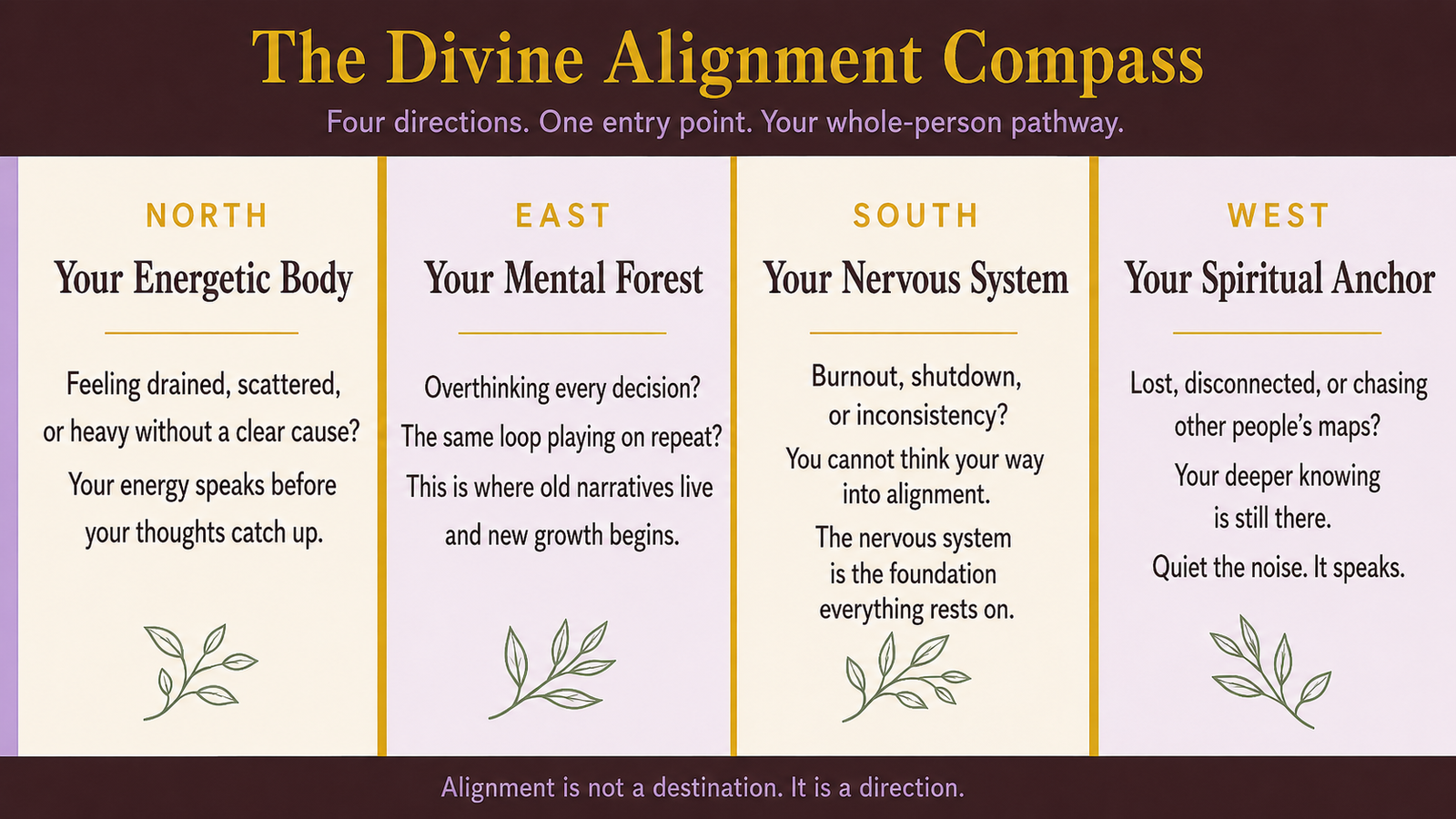
Alignment is multi-dimensional. There is no single lever you pull to get there. The Compass identifies four core directions, and each one holds its own kind of intelligence.
| Direction | Focus | Signs of Disruption | What May Support It |
| North | Energetic Body | Drained, scattered, heavy without clear cause | Energy-based practices, Reiki-informed work |
| East | Mental Forest | Overthinking, looping thoughts, old narratives | Shadow integration coaching |
| South | Nervous System | Anxiety, shutdown, inconsistency, burnout patterns | Nervous system regulation practices |
| West | Spiritual Anchor | Lost, disconnected, chasing external validation | Intuition work, reconnecting to inner direction |
North: Your Energetic Body
Your energy speaks before your thoughts catch up.
Most of us have learned to override subtle energetic signals with mental explanations. “I am just tired.” “It is fine.” “I will push through.” But that low-grade heaviness, that scattered, unfocused feeling, that inexplicable resistance: that is your energetic body trying to communicate.
North is about learning to listen before you override. Energy-based practices, including Reiki-informed practices, may support this dimension by creating space for that energetic information to surface and integrate, rather than be suppressed.
When North is disrupted, strategic planning may not create sustainable momentum until the underlying energetic depletion is addressed.
East: Your Mental Forest
This is where the old growth lives.
Your Mental Forest is full of narratives you inherited, adapted, or built around pain. These are not character flaws. They are default scripts-patterns your mind developed to protect you. Shadow integration coaching works directly in this terrain, bringing those scripts into conscious awareness so they can be examined, updated, or released.
East disruption may look like overthinking every decision. The same conversation playing on loop. Knowing what you want and still somehow not moving toward it.
The work here is not to demolish the forest. It is to tend it, clearing old growth so that new light can reach what is already rooted.
South: Your Nervous System
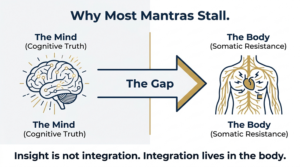
Read this carefully: you cannot think your way into alignment.
You can understand alignment intellectually. You can journal about it, talk about it, and teach it to others. And still, if your nervous system is running a survival pattern in the background, your body may not fully inhabit the expansion you are working toward.
South is the most foundational point on the Compass. Many trauma-informed frameworks suggest that the nervous system functions as the architecture beneath our behavior, our relationships, and our capacity for change. When it is persistently dysregulated, alignment may feel perpetually out of reach, not because you are doing something wrong, but because your system is responding according to patterns it developed for protection.
Regulation is not a spiritual weakness. It may be the physiological foundation that everything else rests on. For more on moving from survival mode into sustainable expansion, read From Surviving to Thriving: Overcoming the Survival Mindset in our blog database.
West: Your Spiritual Anchor
West is about direction, not performance.
Your spiritual anchor is your relationship to your own deeper knowing, the part of you that already senses which way you are called to go. When West is disrupted, you may find yourself chasing external validation, collecting certifications and other people’s maps instead of trusting your own internal compass.
Reconnecting with West is not about forcing clarity. It is about quieting the noise long enough to hear what is already present. Practices that support conscious creation may support this reconnection when they are grounded in embodied truth rather than bypassed aspiration.
How the Divine Alignment Compass Tells You Where to Start
This is the question the Compass is designed to answer.
Most people come into personal development work with a destination in mind. The Compass asks a different question first: where is your system asking for attention right now?
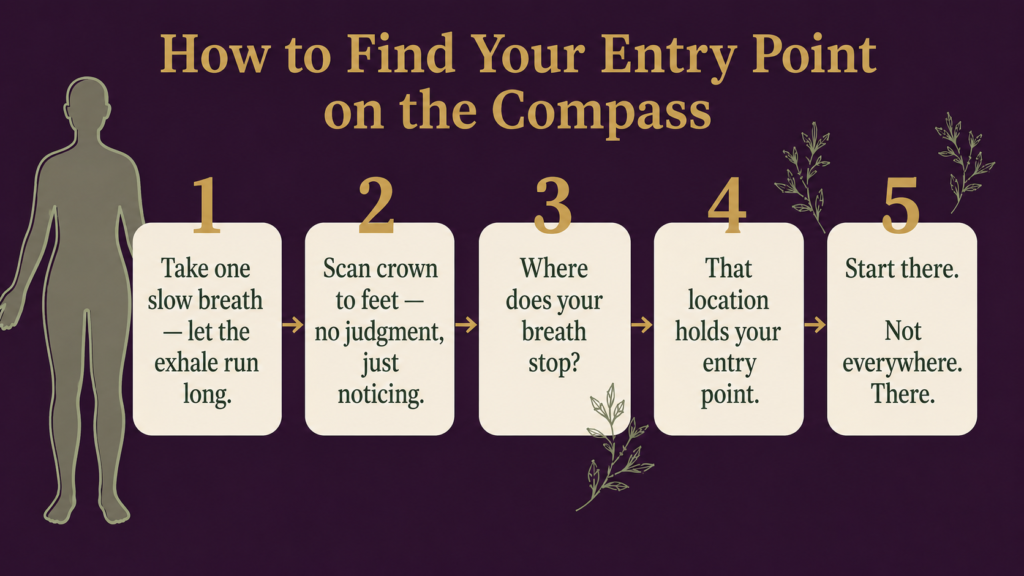
Body Awareness Pause. Pause. Right now. Take one slow, full breath in and release it completely.
Now scan your body, crown to feet. Where do you feel tightness, heaviness, or a subtle brace? Where does your breath stop?
That location may offer a clue about your starting direction. Tension in the chest and throat often points toward North or West: energy and spiritual disconnection. A clenched jaw, tight shoulders, or a hollow feeling in the stomach tends to point South, toward nervous system patterns. A noisy, looping mind that will not slow down is pointing East, toward the Mental Forest.
You do not need to work on everything at once. The Divine Alignment Compass permits you to start exactly where you are.
A growing body of work in holistic and integrative health practice, including frameworks from the American Psychological Association on whole-person care, suggests that meeting the whole person- body, mind, energy, and spirit- may support deeper and more sustainable outcomes rather than addressing any single dimension in isolation.
Why Nervous System Support Changes Everything
Let us go deeper into the South, because this is where most people meet a wall they did not know existed.
Many high-achievers and neurodivergent individuals may be operating from a dysregulated baseline, and may have mistaken that baseline for their personality. The drive. The intensity. The inability to truly rest. The oscillation between overdoing and full shutdown. These may be nervous system adaptations, not character traits.
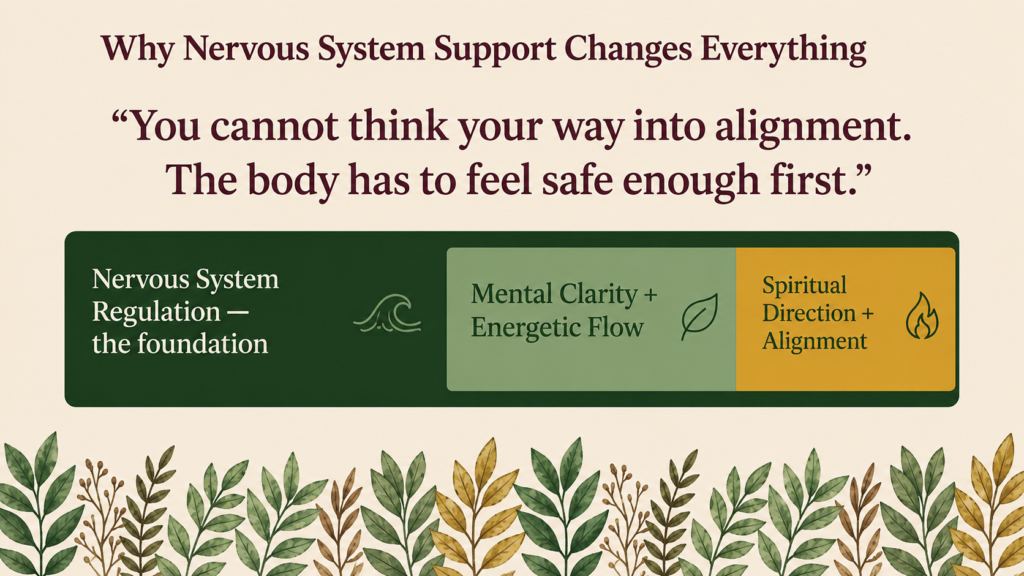
When the system has spent years in fight, flight, or freeze patterns, it may develop a set point as a familiar baseline. That set point may treat expansion as a potential threat. So when you get close to something meaningful, a goal, a relationship, a level of visibility, your system pumps the brakes. This is what people call self-sabotage. But it may be a protection.
Burnout, inconsistency, and the persistent sense of working hard with limited return may be signals of a dysregulated baseline, not evidence of insufficient effort or commitment.
Research on stress and the autonomic nervous system, including studies published through the National Institutes of Health, points to how repeated activation of survival pathways may shape behavioral patterns and the capacity for sustained regulation. Practices that gently and consistently support the nervous system, such as breathwork, somatic awareness, and intentional pacing, may help the body gradually build a new set point over time, one where expansion feels more survivable, and consistency becomes possible because the body is no longer conserving energy for a threat that has already passed.
Alignment tends to live on the other side of that shift.
Why Divine Empowerment Coaching Is the Missing Piece
If standard personal development advice has left you more frustrated than empowered, it is worth saying directly: the problem is not you. It is the mismatch between a one-size-fits-all framework and the very specific nervous system you are working with.
Neurodivergent and high-performing individuals process, adapt, and respond to the world differently. Advice like “just be more consistent” or “show up daily no matter how you feel” can be actively counterproductive for someone whose system is already running on overdrive. The instruction does not account for the nervous system reality underneath the behavior.
Trauma-informed coaching adds the personalization layer that most approaches miss. It brings an understanding of how stress, survival patterns, and lived experience shape not just what you think, but how your body responds to change. It creates space for the whole person, not just the goal-setting version of them.
This approach to divine alignment work is client-led, supportive in nature, and designed to complement, not replace, any licensed medical or mental health care you may be receiving. The aim is not to diagnose or treat. The aim is to facilitate the kind of integrated alignment that generic advice cannot reach. Divine Empowerment Holistic Coaching is where that personalized support begins.
What a Personalized Pathway to Wholeness Looks Like
There is no universal roadmap to alignment. Anyone who hands you one is handing you someone else’s map.
“I am whole as I am.” That is not a destination. It is the starting point.
You are not broken. You are blocked. And blocks have specific locations, specific histories, and specific pathways through them.
A personalized divine alignment pathway begins with your entry point on the Compass. It moves through the work with your system, not against it, building regulation, clarity, and energetic coherence one direction at a time.
This is not about becoming someone else. This is about becoming more fully yourself. And that is a different kind of work than most programs are built for.
This is exactly the terrain where the R.O.O.T. Method works. Root. Orient. Open. Transform. Each stage of the method corresponds to a layer of the Compass, building from the ground up, rather than trying to elevate before you are ready.
Grounding Alignment in the Body: Where Tea Meets Energy Work
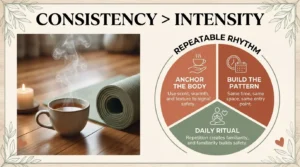
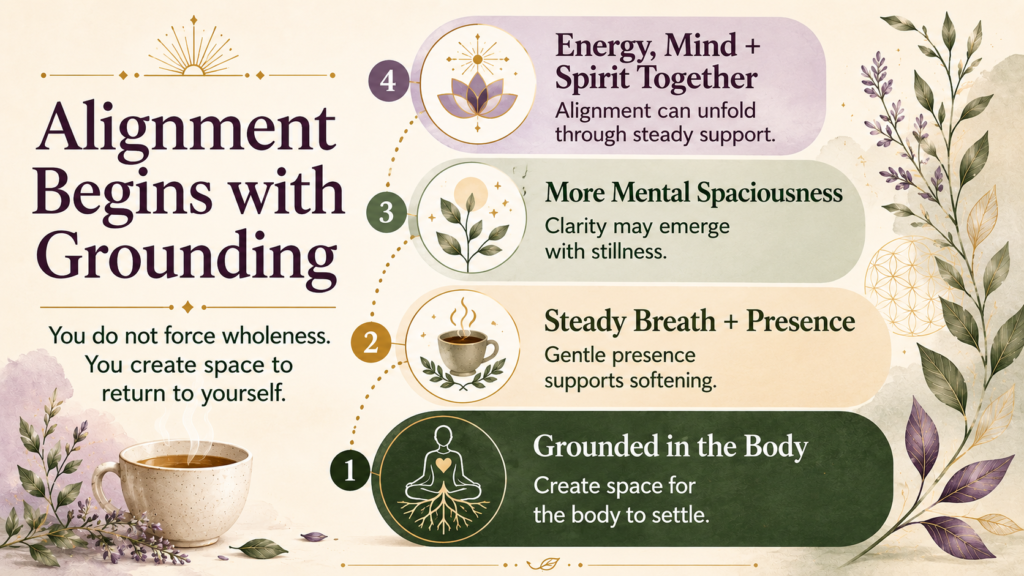
Divine alignment work does not happen in a vacuum. The body needs anchors, small sensory rituals that signal safety and presence to the nervous system between deeper sessions.
This is where the tea ritual comes in.
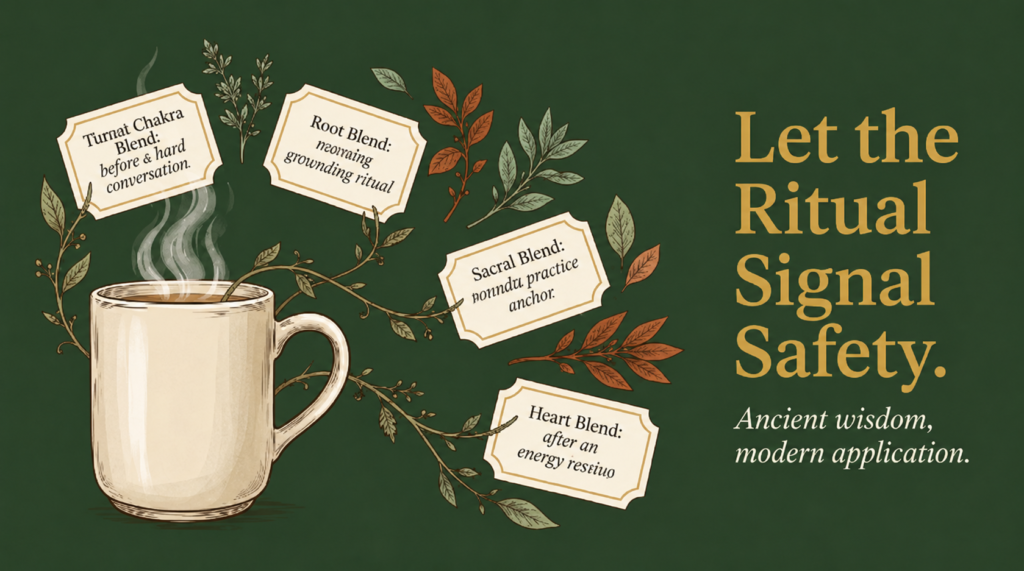
At LMH Custom Teas & Herbs, our chakra balancing tea blends are formulated to support specific energetic centers as part of a daily grounding ritual. Not as a substitute for deeper work, but as a daily anchor. A sensory moment that says to your body: we are here, we are present, we are tending this.
Sipping a throat chakra blend before a difficult conversation or a heart, throat and solar plexus tea for a more difficult conversation. Opening a root chakra infusion as part of a morning grounding practice. These rituals create continuity between energy sessions and everyday life. They make the work livable, not just aspirational.
The next time you brew, hold the warmth of the cup for a moment before you sip. Breathe in. Notice what softens. That is the ritual beginning, and the body remembers every time you show up for it. The body responds to repetition and sensory cues. Build the ritual. Let the roots deepen.
Frequently Asked Questions
What is divine alignment in simple terms?
Divine alignment is the state in which your energetic body, mental patterns, nervous system, and spiritual direction are working coherently together. It is not a permanent elevated state. It is a living, dynamic integration. When these four dimensions are moving in the same direction, life tends to carry a quality of ease and intentionality that many people recognize as flow. When one or more dimensions are disrupted, the whole system signals for attention.
How do I know if I am out of alignment?
The most common signs of disrupted divine alignment may include persistent fatigue without clear cause, the sense of working hard with limited return, repetitive mental loops, difficulty making decisions or trusting your instincts, emotional flatness or reactivity, and a disconnection from your own sense of direction. Your body is often the first to know. Chronic tension, a shallow breath pattern, or an inability to fully rest are all physical signals worth becoming curious about.
Can stored trauma affect spiritual growth?
It can. When the nervous system is running protective patterns, it may treat expansion, including spiritual expansion, as a potential threat. Practices that work only at the mindset or vibrational level can sometimes struggle to create lasting change when the body’s baseline is still oriented toward protection. Trauma-informed approaches may work with the nervous system directly, supporting the physiological conditions that allow deeper integration to occur. This is why nervous system support is the foundational point on the Divine Alignment Compass.
What is the first step to working with the Divine Alignment Compass?
Identify your entry point. Use the body scan described in this post, crown to feet, noticing where tension or heaviness lives. That location may offer a clue to a direction on the Compass, and that direction may be where your system is asking for support right now. You do not need to address everything simultaneously. Start where the signal is loudest.
Is alignment permanent or ongoing?
Divine alignment is ongoing. It is a practice, not a destination. Different seasons of life, new challenges, and significant transitions may activate different points on the Compass at different times. The goal is not to reach a static state of alignment and maintain it. The goal is to develop enough body awareness and inner literacy that you can read the signal, identify your entry point, and move with intention rather than reaction.
What makes trauma-informed coaching different from standard life coaching?
Standard life coaching tends to focus on goals, strategy, and accountability. Trauma-informed coaching adds an understanding of how the nervous system, survival adaptations, and experience may shape a person’s capacity for change. It approaches the whole person, not just their stated goals, and works at a pace that honors the edges of the nervous system rather than pushing past them. For neurodivergent and high-achieving individuals whose systems have been conditioned to perform, this distinction is often the difference between sustainable progress and another cycle of burnout.
Three Things to Carry With You
Alignment is not a destination. It is a living relationship between your body, your mind, your energy, and your spirit. It will shift. That is not failure. That is how it works.
Your body holds the map. The tension, the heaviness, the shallow breath: these are not obstacles. They are directions. Learning to read them is part of the practice.
You do not need more effort. You need the right entry point. And the Compass is built to give you exactly that.
If you are ready to stop navigating alone and start working with a framework that fits your actual nervous system, book your complimentary consultation and let’s map your personal alignment pathway together. Client-led, supportive, and built around you.
Clarity. Balance. Growth. Your journey. Your pace. Your wellness.
If this framework spoke to something in you, stay close. Join the newsletter for grounded reflections and seasonal wellness support delivered at a human pace, and follow Divine Empowerment and LMH Custom Teas & Herbs on social media for daily practices, herb spotlights, and body-based check-ins. If you prefer to go deeper, the YouTube channel pairs each Compass direction with a short guided practice you can return to anytime. And before you go: which direction is asking for your attention first? Share it in the comments, and pass this article along to someone who has been navigating with a broken compass. They may need this map more than you know.
Disclaimer: I am a Certified Coach and Reiki Master; I am not a certified herbalist, licensed medical doctor, or pharmacist. The botanical suggestions, tea profiles, and lifestyle rituals offered on this website and during coaching sessions are for educational and informational purposes only. They have not been evaluated by the FDA and are not intended to diagnose, treat, cure, or prevent any medical condition. I only work with low-risk, culinary, and gentle botanical ingredients. While we charge an advanced assessment premium to meticulously cross-reference your lifestyle plans against any disclosed medications or underlying health conditions, this process is an educational safety check, not a medical review. Always consult your primary healthcare physician before introducing new plants, foods, or supplements into your routine, especially when taking prescription drugs.