You’ve been saying the affirmations. You’ve set the intentions. Maybe you’ve even written the mantras on your mirror in a dry-erase marker so you see them every single morning. And yet, the same pattern keeps growing back. The self-doubt. The overwhelm. The sense that no matter how much inner work you do, the roots run deeper than your words can reach.
That’s not a failure of effort. That’s a gap in the method.
Mantras for self-empowerment are one of the most powerful tools in a holistic practice, but repetition alone is not transformation. The missing piece is transmutation: the deliberate, embodied process of converting stagnant emotional energy into something that can actually move you forward. When you tend your inner landscape with both intention and practice, that’s when a real shift happens.
This is what we’re walking through today. The science, the framework, and the practical steps for making your mantra practice something your whole body believes.
Quick Answer: What Are Mantras for Self-Empowerment?
Mantras for self-empowerment are short, intentional phrases repeated consistently to redirect attention, reprogram thought patterns, and influence emotional state at both the cognitive and nervous system levels. Unlike general affirmations focused on desired outcomes, mantras function as anchoring tools that pull awareness back to a chosen truth, especially when old patterns are running.
Key Takeaway:
- Mantras for self-empowerment help reprogram thought patterns and build inner confidence through repetition, reinforcing positive beliefs and emotional resilience. [1]
- Mechanism: Repeating intentional phrases influences both conscious and subconscious thinking, helping replace negative self-talk with empowering narratives over time. [1]
- Application: Mantras can be spoken, written, or paired with meditation and breathwork to deepen their impact and align mind-body awareness. [2]
- Best practice: Keep mantras simple, present-tense, and personally meaningful (e.g., “I am capable,” “I trust myself”) to make them easier to internalize and repeat consistently. [2]
- Consistency matters: Regular daily use, especially as part of a routine, gradually strengthens self-belief, emotional balance, and long-term personal growth. [1]
Bottom Line: Mantras are a simple but powerful tool for self-empowerment, when practiced consistently, they help shift mindset, reinforce positive identity, and support lasting personal transformation.
- Source: Divine Empowerment Coaching – Mantras for Self-Empowerment
- Source: Divine Empowerment Coaching
Why Do They Work?
Repetition doesn’t just change your mood; it physically changes your brain architecture. Through neuroplasticity, the brain’s ability to reorganize itself by forming new neural pathways, consistent mantra practice actually rewires your internal circuitry.
When you repeat an empowering mantra, you are actively firing specific synapse connections. The neurological rule is simple: neurons that fire together, wire together. In fact, through a process called synaptic pruning, your brain eliminates unused neural connections while strengthening the ones you actively focus on. By consciously choosing your words and internal monologues, you are actively reprogramming the default network of your brain.
Furthermore, the science of neurogenesis shows us that the brain can generate new neurons and pathways throughout our lives. Mantras act as the structural blueprint for this new growth. As detailed in ongoing neuroscience research, altering these synapse connections helps your nervous system build a new baseline for safety, self-trust, and resilience.
What Does It Mean to Tend Your Inner Landscape?
Think of your inner world as a living, breathing ecosystem. Just like a physical garden, if left untended, opportunistic weeds, in the form of old narratives and survival patterns, will continuously return. This isn’t because the gardener failed, but because the soil conditions remain unchanged and the old roots are still drawing nutrients.
Your Inner World Has Seasons Too There are seasons of growth, seasons of decay, and seasons where things go quiet and still, not dead, just resting. Grief looks like a dormant winter. Burnout looks like parched, overworked soil. New clarity feels like the first green shoots breaking through the frost.
Tending your inner landscape means using tools like mantras and energy transmutation to actively cultivate the soil of your mind and body. It means recognizing that what feels like stagnation is often the slow, underground work of a root system reorganizing itself before it can support new growth. You must water the seeds you want to grow, and gently uproot the narratives that drain your energy.
Why don’t they always work?
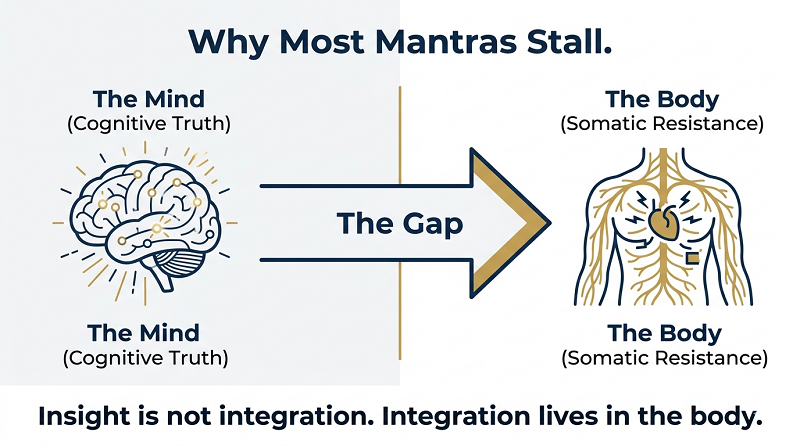
Most mantra practices stall because they stay in the mind. When the body holds unprocessed emotional energy such as anxiety, grief, or chronic tension, a mantra repeated over that resistance lands on top of the feeling without reaching what’s underneath. Embodiment is the missing link.
The most effective approach combines three steps:
- Identify the emotional pattern currently active
- Choose a mantra that meets you where you actually are
- Pair the mantra with a transmutation practice that lets the energy move
What Does It Mean to Tend Your Inner Landscape?
Think about an actual garden. Left untended, the same opportunistic growth returns, not because the gardener failed to want something different, but because the soil conditions haven’t changed. Old roots remain. The ground holds the memory of what was planted there before.
Your inner landscape works the same way.
Your Inner World Has Seasons Too
There are seasons of growth, seasons of decay, and seasons where things go quiet and still, not dead, just resting. Grief looks like winter. Burnout looks like soil that’s been overworked. New clarity feels like the first green after a long freeze.
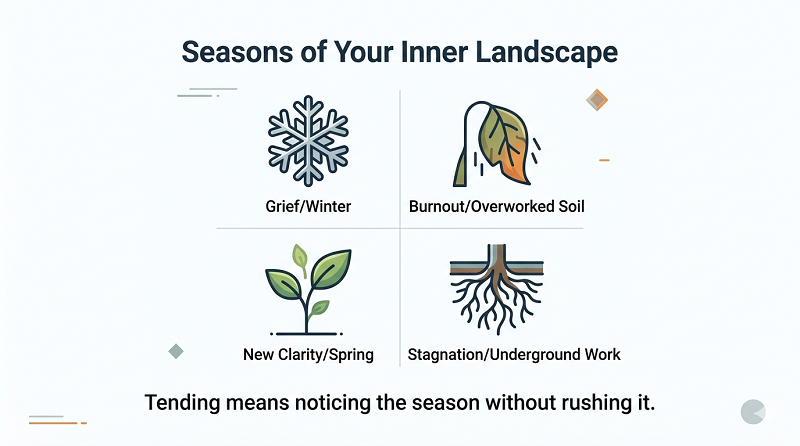
Tending your inner landscape means developing the practice of noticing which season you’re in, without trying to rush it, skip it, or force it into something else. It means recognizing that what feels like stagnation is often the slow, underground work of a root system reorganizing itself before it can bloom.
Why Awareness Alone Leaves Roots Behind
Here is the piece that inner work culture often glosses over: insight is not integration.
You can understand, intellectually, exactly why you do something, the childhood wound, the learned behavior, the coping pattern, and still do it. Understanding lives in the mind. Integration lives in the body. The gap between the two is where mantras stall and where transmutation becomes necessary.
This is the difference between a survival mindset and a thriving one: it’s not about thinking your way to a new reality. It’s about creating the internal conditions where a new reality can take root.
Mantras vs. Affirmations vs. Transmutation: What’s the Difference?
These three tools are often used interchangeably. They are not the same.
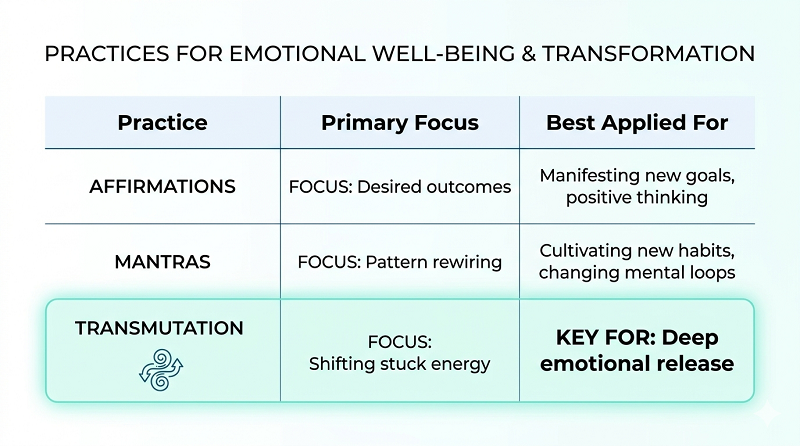
| Practice | Primary Focus | Common Limitation | Best Applied For |
| Affirmations | Positive thinking and desired outcomes | Can feel false before belief catches up | Surface-level mindset shifts and daily mood anchoring |
| Mantras | Repetition, focus, and pattern rewiring | Requires embodiment to hold | Consistent reprogramming of deep thought patterns |
| Transmutation | Shifting stuck emotional or energetic states | Requires awareness and willingness to feel | Deep emotional processing and energetic release |
The most powerful practice is not choosing one of these. It is learning to use all three in sequence, which is exactly what the framework below is built around.
How Does Mantra Practice Actually Work in the Brain?
The Neuroscience of Repetition and Belief
Research published in Social Cognitive and Affective Neuroscience found that self-affirmations activate the brain’s reward centers, increasing resilience and reducing the grip of threat-based thinking. Studies on mantra meditation and self-awareness published in Consciousness and Cognition (2017) suggest that consistent mantra practice alters brain activity in regions tied to self-referential processing. Work from Carnegie Mellon and Stanford researchers found that self-affirmation, used at the right moments, produces measurable improvements in education, health, and relational outcomes.
So the practice works. The question is: why does it so often stall out?
Why Most Mantra Practices Fail
Affirmations don’t fail because they’re wrong. They fail because your body doesn’t believe them yet.
You can repeat “I am calm and capable” forty times while your chest is tight, your jaw is locked, and your nervous system is running a survival-level threat response. The words are landing on top of the sensation without touching what’s underneath. This is cognitive dissonance, and your body knows the difference between a truth and a wish.
Nervous system resistance to new beliefs is not a character flaw. It is a protective function. The limbic system, which houses the amygdala and hippocampus, is wired to preserve familiar patterns, even painful ones, because familiar feels safe. Changing that wiring requires more than repetition. It requires transmutation.
The Missing Piece: Energy Transmutation
Transmutation is an old alchemical concept: the transformation of one substance into another. In the context of inner work, it refers to the deliberate conversion of heavy, stuck, or unprocessed emotional energy into something that can move, shift, and eventually serve your growth.
What Transmutation Is Not
It is not toxic positivity. Transmutation is not “just choose joy” or “reframe the negative thought” or burying a feeling under a brighter one. That’s suppression. Suppression doesn’t transform energy. It internalizes it.
As one trauma-informed perspective on emotional transmutation describes it: when we suppress our emotional or energetic experience, we don’t erase it. We internalize it. It shows up as fatigue, reactivity, disconnection. When we meet that energy with awareness and honesty, it can shift. It can move. And in that movement, it can free us.
What Stuck Energy Actually Feels Like in the Body
Stuck energy is not abstract. It lives in the body as tightness across the chest when a certain topic comes up, a familiar heaviness that descends when you face a particular task, looping thoughts that circle the same story without resolution, or the impulse to pull away right when something good is starting.
Take a breath right now. Notice if any of those landed somewhere in your body just from reading them. That noticing is the beginning.
How the Nervous System Responds to Emotional Shifts
Research on affect labeling, the practice of naming what you feel, shows that simply identifying an emotion decreases activity in the amygdala and increases regulatory activity in the prefrontal cortex. This is the neurological foundation of transmutation: naming and consciously engaging with a feeling begins to change how the brain processes it.
The goal is regulation, not suppression. Regulation means you can feel the feeling without being swept away by it. That regulated state is exactly where a mantra can land with full power.
The R.O.O.T. Method: A Framework for Real Inner Change
This four-step practice brings mantras and transmutation together into a coherent, repeatable process. You can use it in two minutes or twenty. The depth is up to you.
Step 1: Recognize — Name What’s Growing
Before you can tend something, you have to see it clearly. What emotion, pattern, or belief is active right now? Name it without judgment. “I am feeling afraid of being seen.” “I keep shrinking before I speak.” “I am running an old story about not being enough.”
This is not about analyzing why. It’s about seeing what is actually growing in this moment, the way a gardener walks the rows without yet pulling anything up.
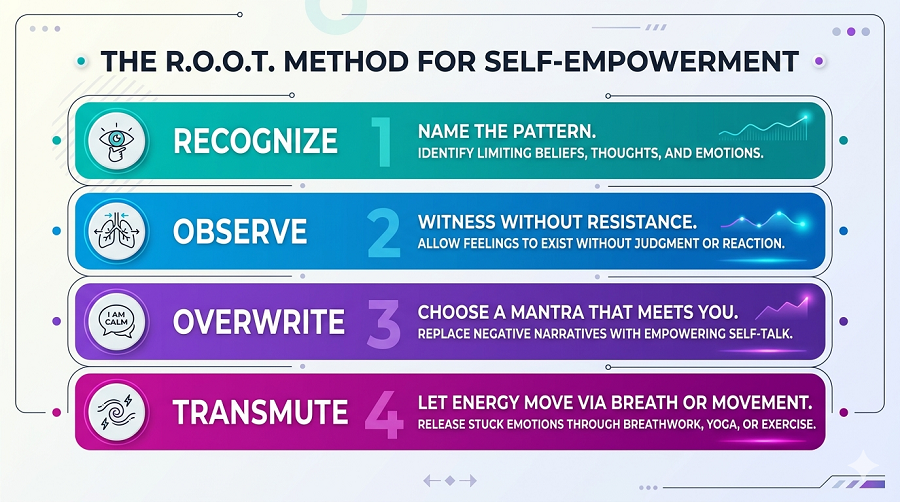
Step 2: Observe — Witness Without Resistance
Place one hand on your chest or belly. Breathe in for four counts, hold for four, exhale for six. Notice where the feeling lives in the body. Is it tight? Heavy? Hot? Moving or still?
The practice of emotional observation tells us that acceptance, allowing the emotion to exist without trying to push it out, is the first step toward any real transformation. Resistance locks energy in place. Observation begins to loosen it.
You are not fixing anything here. You are simply witnessing.
Step 3: Overwrite — Choose a Mantra That Meets It
Now, not before, introduce the mantra. The key is choosing a phrase that meets you where you actually are, not where you wish you were. A mantra that overreaches creates more dissonance.
If you feel overwhelmed, “I am joyful and free” may land like a lie. But “I am capable of moving through this moment” is true, and your body can find it.
Some mantras that work with your energy rather than against it:
- “I show myself grace in all things.”
- “I am learning to feel safe in expansion.”
- “I release what is not mine to carry.”
- “I am whole as I am, and I am becoming more.”
- “The ground beneath me holds. I do not have to hold everything.”
These phrases are not declarations of a destination. They are invitations into a process, which is exactly what an abundance-oriented inner life is actually built from: small, honest shifts repeated with intention.
Step 4: Transmute — Let the Energy Move
Repeat your chosen mantra while giving the stuck energy somewhere to go. Options include:
Breathwork: The 4-7-8 pattern, inhale for 4, hold for 7, exhale for 8, activates the parasympathetic nervous system and creates physiological calm that supports the mantra’s landing.
Movement: Walk, stretch, shake your hands out, roll your shoulders. Emotional energy is meant to move. When you pair physical movement with your mantra, you are asking the whole body, not just the mind, to participate in the shift.
Somatic release: Place your hands on your heart, breathe, and consciously exhale whatever you named in Step 1. You are not forcing it out. You are creating a door and choosing to open it.
Energy work: For patterns that feel deeply rooted, the ones that have been growing for years, an energy-based session can reach what personal practice alone cannot. Energy-based practices, including Reiki-informed work, support the transmutation process by restoring flow within the body’s energetic systems and facilitating release at a somatic level. These sessions are supportive and complementary, not a replacement for healthcare, and a powerful companion to it.
A Real Example: Turning Anxiety Into Empowerment
Here is what the R.O.O.T. method looks like in action.
The trigger: You’re about to speak up in a meeting, send a vulnerable email, or start a project that matters. The anxiety floods in.
The old pattern running: “I can’t handle this. I’ll mess it up. Better wait.”
Recognize: I feel fear around being visible. It lives in my throat and chest.
Observe: Hand on chest. Four-count breath. The tightness is there. I name it. I don’t push it away.
Overwrite: “I am capable of moving through this moment. My voice has value. I show myself grace in all things.”
Transmute: Three full exhales, shoulders back, feet planted. One small action: send the email, say the thing, open the document.
The pattern does not disappear after one round. Roots take time to release. But each time you walk this process, you are changing the soil conditions of your inner landscape. Over time, the old growth has less to hold onto.
This is what manifesting through intention and aligned action actually looks like at the ground level. Not a vision board. A daily, embodied practice of tending what is growing inside you.
Common Mistakes That Keep the Pattern Stuck
Naming these plainly, because awareness of the pitfall is half the step around it.
Forcing a mantra before you’ve observed the feeling. If you skip Steps 1 and 2, the mantra has no landing place. You’re spraying water on concrete.
Using mantras to suppress emotions. A mantra chosen to make you stop feeling something will backfire. The goal is to move the energy, not bury it.
Expecting instant results. A single session of this practice can create real, noticeable shift, and the deeper patterns need repeated tending. You are not broken because it takes more than one round.
Skipping the body entirely. The mind is not the whole system. If your mantra practice lives only in your head, it is missing the terrain that needs tending most.
Weaving This Practice Into Your Daily Life
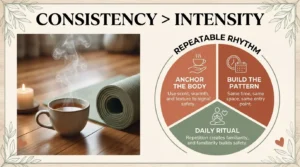
You do not need a ceremony. You need consistency.
The Tea Ritual as a Somatic Anchor
One of the simplest ways to create a daily mantra and transmutation practice is to pair it with something you already do. The act of preparing and drinking tea, specifically the warmth, the scent, the slowing down it invites, is a natural somatic anchor. It signals to the nervous system: we are shifting modes.
The LMH Tea chakra blend collection was formulated with this in mind. Each blend corresponds to an energetic center, root, sacral, solar plexus, heart, throat, third eye, and crown, and the sensory experience of drinking them becomes part of the grounding ritual that prepares the body to receive a mantra at depth. Ancient wisdom, modern application. That’s what this is.
For those looking for a more personalized experience, you can also book a free custom tea consultation.
Before you sit with your tea, name one thing you are tending in yourself today. Choose a mantra from the list above or write your own. Let the warmth of the cup be the beginning of Step 2.
Micro-Practices for Busy Days
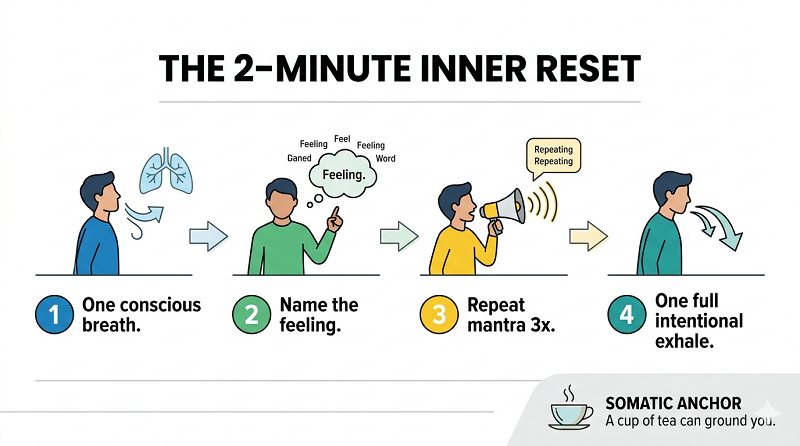
When life doesn’t allow for a full practice, compress it: one conscious breath, one word to name the feeling, your mantra said aloud or internally three times, and one full exhale with intention.
Two minutes. That’s enough to plant a seed, even on a hard day. Life is better with tea, and it is better when you tend what is growing inside you, one breath, one mantra, one honest exhale at a time.
When to Seek Deeper Support
Personal practice is powerful. And some patterns are rooted below the reach of solo work.
If you notice the same emotional pattern cycling despite consistent practice, if anxiety, self-doubt, or contraction feel chronic rather than situational, that is not a sign you are doing it wrong. That is a sign the root system runs deep, and supported work is worth considering.
Holistic empowerment coaching offers a structured, trauma-informed container for exactly this: identifying the belief systems and behavioral patterns that consistent journaling and solo practice haven’t shifted, and building a real, sustainable path through them. Your journey. Your pace. Your wellness. You do not have to walk it alone.
Energy-based sessions are also available upon request as a complement to ongoing practice, supporting the body’s energetic systems in ways that talk-based work sometimes cannot reach.
FAQ: Your Questions About Mantras and Transmutation, Answered
What Mantras Should I Use for Self-Empowerment?
The most effective mantras for self-empowerment are phrases your body can believe right now, not declarations of where you want to be, but honest invitations into a process of becoming. Overreaching creates cognitive dissonance. A mantra that meets your actual emotional state creates traction.
The right mantra will feel slightly stretching but not false. If it feels completely untrue, scale it back one step toward where you are. “I am calm” may not land. “I am learning to return to calm” usually does.
How Do I Know When a Mantra Is Actually Working?
You will not always feel a dramatic shift. More often, the signs are quieter. Watch for reduced resistance when the pattern is triggered, a moment of pause where the old reaction used to be automatic, physical softening in the chest or jaw when you say the phrase, and small behavioral changes where you act differently than you used to.
Neuroscience research on mantra practice indicates that meaningful change in self-referential brain activity takes consistent practice over at least several weeks. This is not a reason to doubt the practice. It is a reason to tend it the way you would tend any living thing in your inner landscape, with patience, repetition, and without demanding it bloom on your timeline.
Why Does Energy Transmutation Make Mantras More Effective?
Energy transmutation addresses what mantras alone cannot reach: the body. When emotions are unprocessed, they create physiological patterns such as tension, shallow breathing, and postural collapse that signal “threat” to the nervous system. A mantra introduced into that state is working against the body’s own resistance.
Transmutation practices, including breathwork, movement, somatic release, and energy-based sessions, shift the body’s physiological state first. They support regulation of the nervous system, creating internal conditions where a new belief can actually land. Think of it this way: transmutation prepares the soil. The mantra plants the seed. You cannot plant in concrete and expect anything to grow.
What Is the Difference Between Transmutation and Suppression?
Suppression pushes an emotion down without processing it. The feeling goes underground but does not leave. It resurfaces as fatigue, reactivity, physical tension, and behavioral patterns that seem unrelated to their origin.
Transmutation meets the emotion fully and consciously redirects its energy into something that can serve growth. The distinction is willingness to feel. Suppression avoids. Transmutation witnesses, then moves. Energy-based practices support this process by restoring flow within the body’s energetic systems, facilitating release rather than forcing it.
Your Inner World Is Not Broken. It’s Untended.
The same pattern keeps growing back not because you are failing, but because the conditions for something different haven’t been fully established yet. That is workable. That is exactly what this practice is for.
Start today, wherever you are. Name what is growing. Witness it. Choose a phrase that meets it. Let the energy move.
If you are ready to go deeper, if something in this piece stirred a recognition that solo practice alone won’t reach, explore a holistic coaching session or an energy-based session as the next step. Clarity. Balance. Growth. One honest, grounded choice at a time.
You may also schedule a complimentary consultation prior to booking to explore which support option best aligns with your current needs.
Disclaimer: Services are supportive and educational in nature and are not a substitute for medical, psychological, or licensed healthcare. Clients should consult qualified healthcare providers for medical or mental health concerns.